
This month, things got concrete: we carried out our first scan with a test person and gained important insights for our further process. Here's an overview.
Our First Scan with a Test Person
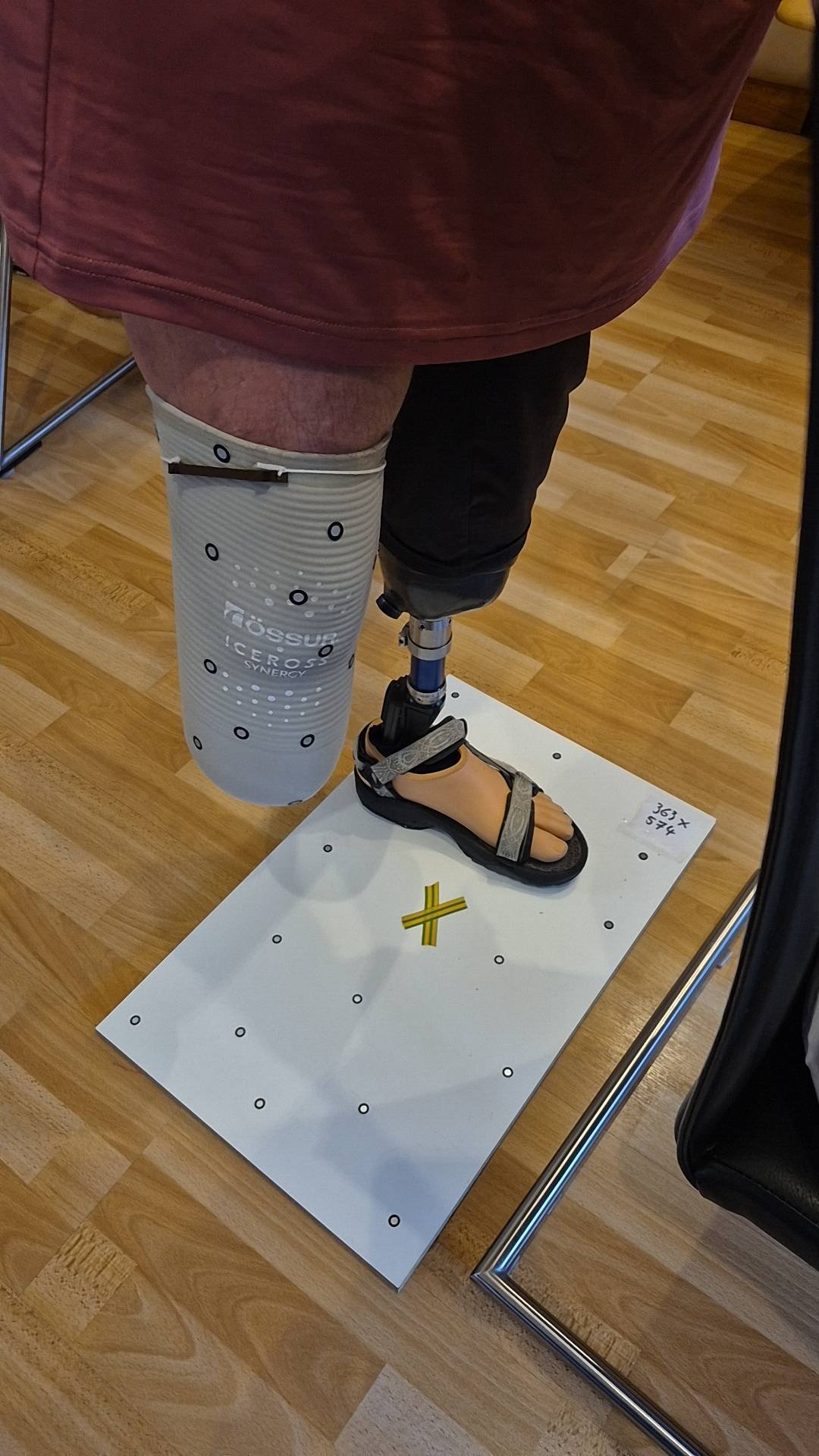
Together with Uwe, a boardmember of the amputee self-help association LVampNRW, we tested the scanning process on-site for the first time. We not only tested different modes of a smartphone scanning app, but also compared them directly with a professional laser scanner: the AR-based photo mode proved unsuitable for our requirements, as it captured surrounding objects alongside the leg. The video-based scan delivered significantly better results, allowing us to generate a usable 3D model in about 60 seconds.
Uwe's feedback on the prosthesis was also particularly valuable. For him, a well-fitting liner and a functioning rollover mechanism are the most important thing. The bone structure in particular plays a decisive role, as he reports: "During the scans, I noticed how important it is to pay attention to the bone structure. Palpating the residual limb beforehand helps identify particularities and take them into account when printing the prosthesis." Direct user feedback like this helps us align our development even more closely with actual needs.
Scaling and Scan Accuracy
Following our first successful scans, we're now working on reliably scaling the models. Since a 3D-printed reference object isn't always captured correctly, we're testing alternatives. With the smartphone app Kiri Engine we use, there was no noticeable distortion and a deviation of only about 2 mm, a promising result for our current stage of development.
Software Becomes More Accessible
We're working on an installer that will let the Enevra software run without a Python installation in the future, an early version is already being tested on Windows. We're also developing the concept for an online course on 3D printing and 3D scanning, so we can better train our partners in producing better prostheses.
Outlook
In the coming weeks, we'll turn the insights from our first test-person scan into concrete improvements, especially regarding scaling and the scan process. At the same time, based on his direct feedback, we're producing a new liner and the matching, custom-fit leg prosthesis for Uwe. In parallel, we'll continue developing and testing our hardware prototypes.
Stay Tuned
Soon you'll be able to sign up directly on our website for our email newsletter, so you never miss an update. Just stop by https://www.enevra.com/. On Instagram (@enevra.enactus), we also share all the latest news with even more insights.
And if you know someone who might find our work interesting, feel free to forward this newsletter along.
Until next time!
Your Enevra Team