
It's been a while, but things have been anything but quiet: from passed load tests to the preparations for our first participant study, a lot has happened at Enevra since the last newsletter. Here's an overview.
Preparing our first participant study
Preparations for our first participant study in Germany are in full swing. We're currently finalising the scanning process and comparing different scanning methods: professional scanners on one side, smartphone-based photogrammetry via an existing app on the other. The scan forms the basis for our software, which turns it into the printable files for the prosthesis. A first in-person meeting with a participant is already scheduled.
By comparing these two scanning methods, we're pursuing one central question: how accessible and affordable can we make the scan without losing accuracy?
Software and hardware
Our prosthetic software has moved to the official Enevra GitHub organisation, giving the software team a cleaner structure for working together. Alongside this came new adjustment options for prosthetic components.
On the hardware side, we've further optimised the liner and the prosthetic foot. New prototypes were manufactured, and our material and manufacturing tests are bringing us closer to a production process that will allow individual requests to be met on site.
600,000 steps – and still standing
In June, our leg prosthesis prototype passed its first dynamic load test: 600,000 load cycles without failure. To put that into perspective, this corresponds to roughly 8 to 12 months of everyday walking, an important first milestone on the way to the 3 million cycles that ISO 10328, the international standard for lower-limb prostheses, sets out for the long term. For us, this is more than a technical figure. It's the first solid proof that a prosthesis you can genuinely walk on is within reach.
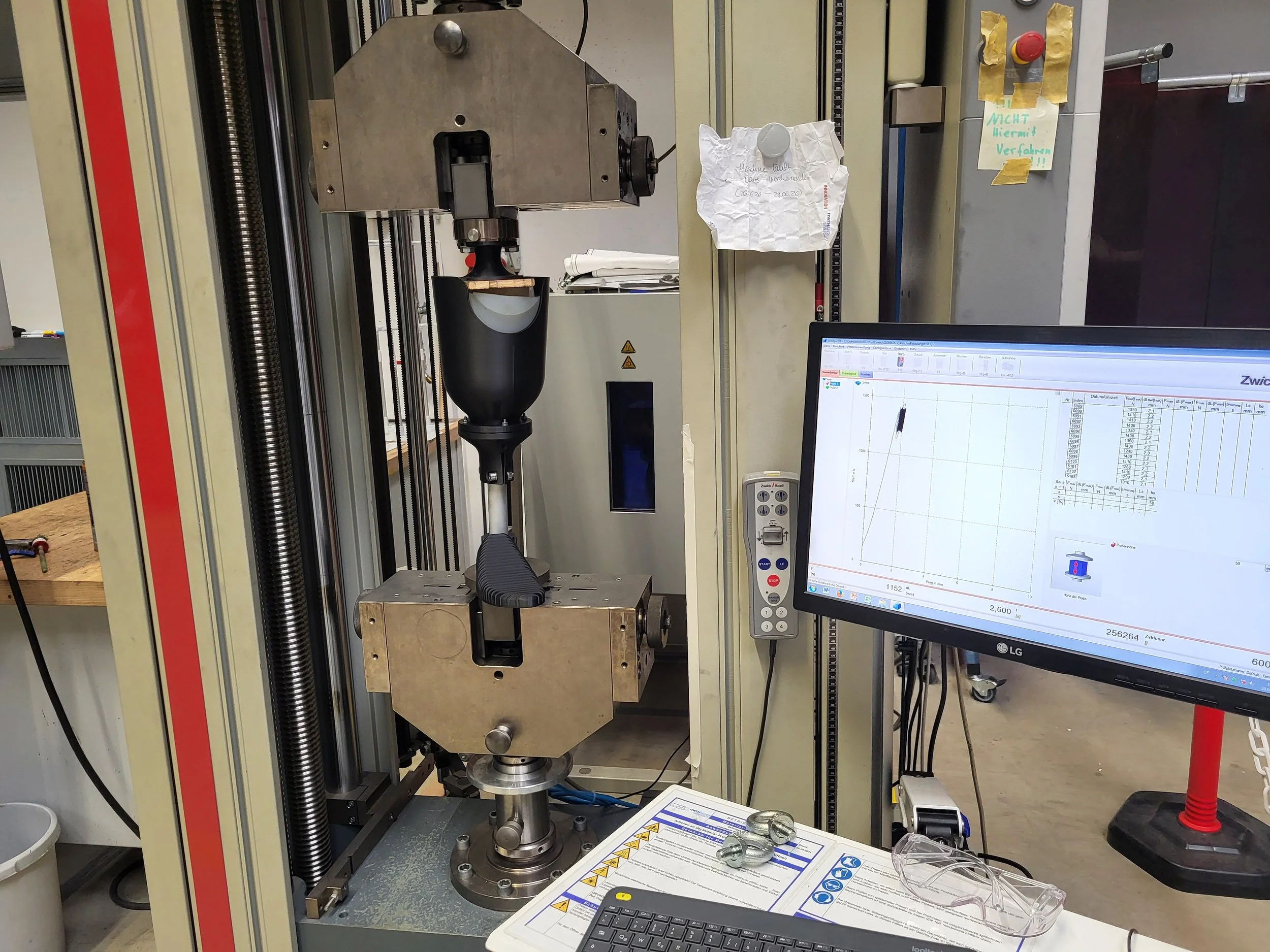
Ongoing testing of the leg prosthesis on the tensile-compression testing machine
Outlook
Next, we'll meet one of the participants from our study in person to try out both scanning methods on site and to test the prosthesis, including the liner, on a real person for the first time. It's the moment when raw data becomes something wearable for the very first time. Their feedback will then feed directly into the further development of our hardware and software.
Our programmers Pedro, Fatima and Finn are continuing to work on the software. The goal is to produce a precisely fitting prosthesis, including the silicone socket, directly from a simple scan. This would make a step that until now required specialist workshops far more accessible.
Based on the results, we'll then set our sights on the next major goal: a first pilot project in the future target region, where the prosthesis is ultimately meant to be printed.
Stay with us
From now on, you can register directly on our website for the email newsletter, so you'll never miss an update. Just head over to News and scroll all the way down. On Instagram (@enevra.enactus), we also share all the latest news with even more insights. And if you know someone working in prosthetics, materials research or 3D printing, feel free to forward this newsletter.
Thanks for reading. See you next month!